

How to Pass the CDL Road Test: Complete Guide for New Drivers
 EMILY
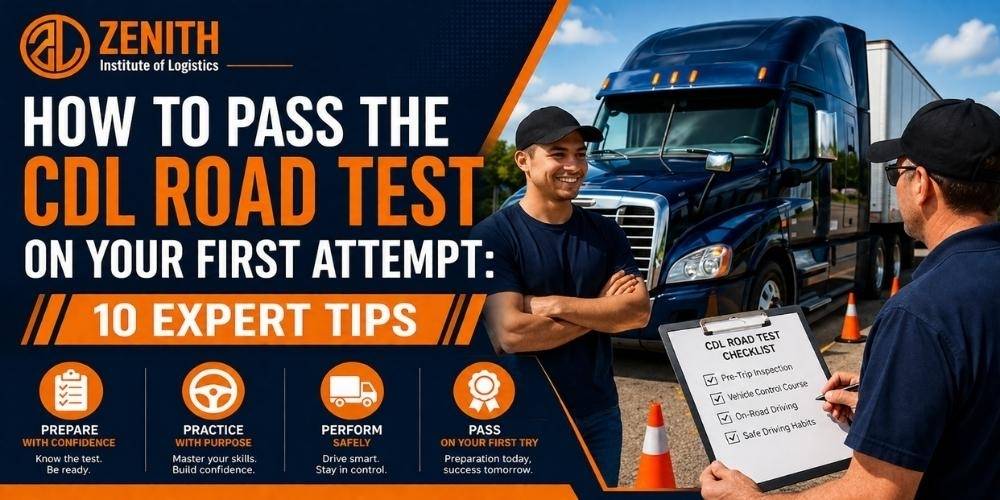
EMILY Passing the CDL road test requires more than knowing how to drive a commercial vehicle. You must show that you can inspect your vehicle, control it during basic maneuvers, and drive safely in real traffic. The CDL skills test generally includes three parts: the Vehicle Inspection Test, Basic Control Skills Test, and Road Test.
Knowing what to expect can make preparation much easier. This guide explains each part of the CDL skills test, the skills you need to demonstrate, common mistakes that can affect your result, and practical tips to help you prepare for test day. Whether you are preparing for a Class A CDL driving test or taking the test for the first time, you will know what to practice and review beforehand.
What Is the CDL Road Test?

The CDL road test is the on-road portion of the CDL skills test. It evaluates whether you can safely operate a commercial motor vehicle in traffic while following road rules, using proper driving techniques, and maintaining control of the vehicle.
The broader CDL skills test generally includes three parts:
- Vehicle Inspection Test: Demonstrate that you can identify important vehicle components and explain what you would check before operating the vehicle.
- Basic Control Skills Test: Demonstrate safe control of the vehicle during required low-speed maneuvers. Depending on the state and applicable testing procedures, these may include straight-line backing, stopping, and offset tracking maneuvers.
- Road Test: Drive on public roads while demonstrating safe turns, lane changes, braking, signaling, speed control, lane positioning, and overall vehicle control.
The exact procedures and scoring requirements can vary by state, so always review the current requirements for the state where you will take your test.
CDL Road Test Checklist
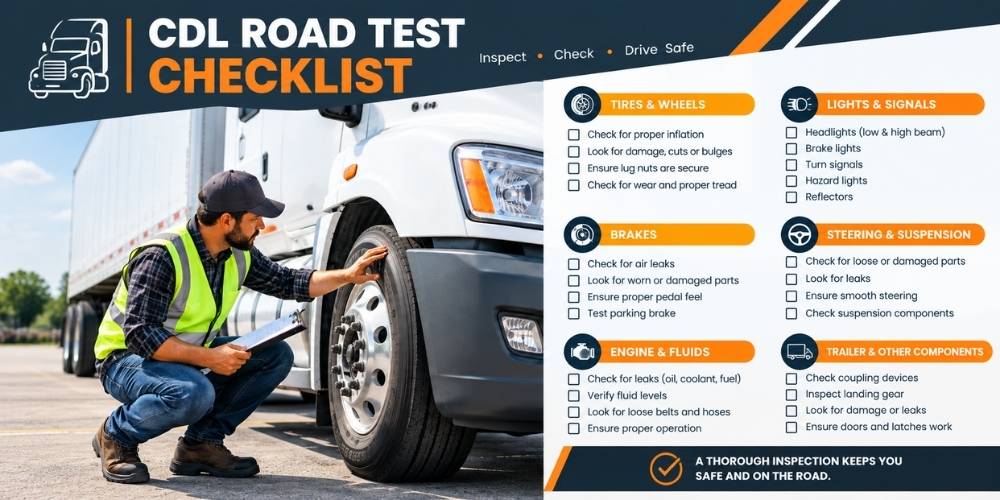
Use this checklist to organize your preparation before test day.
Before the Test
- Confirm your test appointment and location
- Review the required documents
- Check that your test vehicle meets applicable requirements
- Review the inspection procedure
- Get adequate rest before the test
Vehicle Inspection
- Know the required inspection sequence
- Identify important safety components
- Understand what you are checking and why
- Review common vehicle defects
Basic Vehicle Control
- Practice straight-line backing
- Forward and Reverse Offset Tracking
- Use mirrors consistently
- Maintain accurate vehicle positioning
- Make controlled steering corrections
On-Road Driving
- Check mirrors regularly
- Use turn signals correctly
- Maintain proper lane position
- Control your speed
- Make complete stops
- Follow traffic signs and signals
- Listen carefully to the examiner’s instructions
How to Prepare for the CDL Road Test
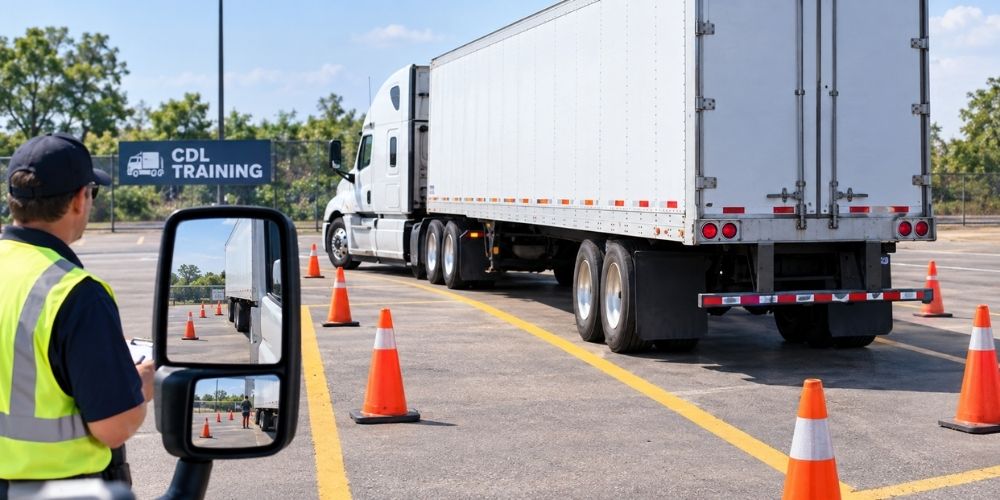
The best preparation is not simply driving for more hours. Focus on the specific skills you will be evaluated on and practice them until your movements become controlled and consistent.
1. Master the Pre-Trip Inspection
Start by learning the inspection sequence required by your state. Practice identifying the components you need to check and explaining what you are looking for.
Do not simply memorize a list of parts. Understand what makes a component safe or unsafe so you can complete the inspection accurately under test conditions.
If you are preparing in Texas, use the current Texas Commercial Motor Vehicle Driver’s Handbook and applicable DPS materials as your reference.
2. Practice Basic Vehicle Control
Basic vehicle control requires accuracy, especially at low speeds. Do not spend all your practice time driving on highways or open roads.
Practice maintaining the correct position, controlling your steering, stopping at the required points, and making smooth corrections. The goal is to control the vehicle deliberately rather than making sudden or repeated steering adjustments.
3. Spend Extra Time on Backing
Backing requires precise control, so practice it until your steering corrections become small and predictable.
Work on:
- Straight-line backing
- Required offset maneuvers
- Trailer positioning
- Mirror use
- Controlled steering corrections
- Stopping and reassessing your position
Do not rush through backing exercises. Focus on maintaining control and understanding how each steering movement affects the vehicle.
4. Practice the On-Road Portion
Once your basic vehicle control is comfortable, practice the situations you may encounter during the road test.
Focus on:
- Right and left turns
- Lane changes
- Intersections
- Traffic signals
- Railroad crossings, when applicable
- Curves
- Starting and stopping
- Maintaining lane position
- Proper speed control
- Mirror checks and signaling
Practice on different roads and in different traffic conditions when possible. This helps you develop skills that are not dependent on one familiar route.
5. Take a Mock CDL Road Test
A mock test can reveal problems that are easy to overlook during normal practice.
Ask an instructor to observe you from start to finish without constantly correcting every small mistake. Afterward, review where you missed a step, lost control, needed excessive prompting, or made an unnecessary correction.
This gives you a clearer idea of what needs more practice before the actual test.
CDL Road Test Maneuvers You Should Practice
Some maneuvers require precise vehicle control and deserve extra attention during your training.
1. Straight-Line Backing
Practice keeping the vehicle moving backward along the intended path. Use your mirrors, make small steering corrections, and avoid unnecessary movements.
2. Offset Maneuvers
Practice positioning the vehicle accurately while moving between designated areas. Pay attention to the tractor, trailer, boundaries, and reference points. Make one controlled correction at a time instead of constantly turning the steering wheel.
3. Forward Stop
Practice bringing the vehicle to a smooth, controlled stop at the required position. Focus on braking control, vehicle positioning, and stopping accurately.
4. Turns
Practice setting up each turn correctly before entering the intersection. Control your speed, check your mirrors, maintain proper lane position, and allow enough space for the vehicle and trailer to complete the turn safely.
Common CDL Road Test Mistakes That Can Cause Problems
Small mistakes can affect your performance during the CDL road test. Pay close attention to these common problems.
1. Rushing
Moving too quickly can lead to missed checks, poor positioning, or unnecessary corrections. Focus on controlled movements rather than speed.
2. Missing Mirror Checks
Check your mirrors regularly, especially before turns, lane changes, backing, and other situations where surrounding traffic or vehicle position can change.
3. Poor Lane Position
Maintain proper lane position and account for the size and movement of your commercial vehicle.
4. Turning Too Quickly
Control your speed before and during turns. Give the vehicle enough space to complete the maneuver without striking curbs, objects, or other vehicles.
5. Overcorrecting While Backing
Avoid making several large steering corrections in a short period. Make a small adjustment, watch the vehicle’s movement, and correct again when necessary.
6. Incomplete Stops
Come to a complete stop at required stopping points and before proceeding through applicable intersections or other controlled areas.
7. Ignoring Instructions
Listen carefully to the examiner and follow each instruction as given. If you are unsure about an instruction, make sure you understand it before continuing.
What Should You Bring to Your CDL Road Test?
Testing requirements vary by state and testing location, so review the current instructions before your appointment.
Depending on your situation, you may need:
- Commercial learner’s permit
- Identification
- Required testing documents
- Properly equipped test vehicle
- Current vehicle registration
- Proof of insurance
- Other state-required documentation
For Texas applicants, review the current Texas DPS CDL testing requirements before arriving at the testing location. Having the correct documents and a compliant test vehicle can help prevent avoidable delays or problems on test day.
What Should You Do the Day Before Your CDL Road Test?
The day before your test should focus on reviewing your skills, preparing your documents, and getting yourself ready for the appointment.
Review Your Pre-Trip Inspection
Go through your inspection sequence once or twice. Make sure you know what you are checking and what problems you are looking for.
Practice Your Weakest Maneuver
Use your remaining practice time on the skill that needs the most improvement, whether that is backing, turning, vehicle positioning, or another required maneuver.
Prepare Your Documents
Gather all required documents and keep them together so you are not searching for anything on test day.
Check Your Test Vehicle
If you are providing the vehicle, make sure it meets the applicable testing requirements and is ready for inspection.
Get Enough Sleep
Get adequate rest so you can stay alert and focused while operating the commercial vehicle during the test.
CDL Class A Driving Test: What Should You Practice?
If you are preparing for a Class A CDL driving test, you need to demonstrate control of the tractor-trailer combination while maintaining awareness of both the tractor and trailer.
Tractor-Trailer Control
Practice smooth acceleration, braking, steering, and lane positioning. Pay attention to how the trailer responds to your steering and speed changes.
Trailer Backing
Practice using your mirrors consistently and making small steering adjustments. Learn to recognize trailer movement early so you can make corrections before the trailer moves too far from the intended path.
Turns and Intersections
Practice setting up turns correctly, controlling your speed, checking mirrors, and allowing enough room for the tractor and trailer to complete each maneuver safely.
Lane Changes
Check your mirrors, signal properly, monitor surrounding traffic, and make controlled lane changes while maintaining proper lane position.
Practice With a Suitable Test Vehicle
Practice with a vehicle that is representative of the type you expect to use for your test. Familiarity with the vehicle’s dimensions, handling, mirrors, and controls can make it easier to focus on the skills being evaluated.
What Happens If You Fail the CDL Road Test?
Failing the CDL road test does not mean you need to start your training over. Instead, identify the areas that caused problems and use your test results to guide your next practice sessions.
Depending on the test and state requirements, review areas such as:
- Pre-trip inspection
- Basic vehicle control
- Backing maneuvers
- Turns and lane changes
- Traffic signals and intersections
- Vehicle positioning
- Other areas identified in your test results
Focus your next practice sessions on the skills that need the most improvement rather than repeating everything equally.
How Many Mistakes Can You Make on a CDL Road Test?
There is no single nationwide number of mistakes that applies to every CDL road test. States administer their skills tests under federal standards, but specific scoring procedures and failure criteria can vary.
Be cautious about online advice claiming that every CDL applicant can make a specific number of mistakes and still pass.
If you are testing in Texas, review the current Texas DPS skills-test materials for the applicable scoring and failure rules. Certain actions, including excessive deductions, accidents, dangerous driving, failure to cooperate, or violations of law, can affect the test result.
Frequently Asked Questions About the CDL Road Test
What should I practice most before the CDL road test?
Focus on the skills you will be evaluated on, especially the pre-trip inspection, basic vehicle control, backing maneuvers, and on-road driving.
Can I use a different truck for practice than the one used for my test?
You can practice in a different vehicle, but training in a vehicle similar to your test vehicle can help you become familiar with its dimensions, mirrors, controls, and handling.
Should I practice the entire CDL test in order?
Yes. Complete practice runs that follow the full testing sequence can help you identify weak areas and become comfortable moving from one part of the test to the next.
What should I do if I make a mistake during the CDL road test?
Stay focused and continue following the examiner’s instructions. Avoid letting one mistake lead to additional errors, and remember that the scoring effect of a mistake depends on the state’s testing rules.
Is backing harder than the driving portion of the CDL test?
That depends on the driver. Backing requires precise vehicle control, while the road portion requires you to manage traffic, lane position, turns, signals, speed, and other driving situations.
How can I prepare for a Class A CDL road test?
Practice pre-trip inspection, tractor-trailer control, backing, turns, lane changes, intersections, and other skills required by your state. A mock test can also help identify areas that need additional practice.

Conclusion
Passing the CDL road test requires preparation for every part of the skills test, not just the time spent driving on public roads. Learn your pre-trip inspection, practice basic vehicle-control and backing maneuvers, and work on turns, lane changes, intersections, and other on-road skills until you can perform them smoothly and consistently.
Not sure which CDL skills you need to practice before test day? Zenith Institute of Logistics provides hands-on CDL training focused on vehicle control, backing, road skills, and CDL test preparation. Our instructors help you build practical driving skills and identify areas that need more practice before you take your test. Contact Zenith Institute of Logistics today to learn more about our CDL training programs.
Recommended Posts

What Can You Do With a CDL? Jobs, Careers, and Opportunities
October 15, 2026
Can You Get a CDL With a DUI or DWI? Eligibility Guide
June 11, 2026